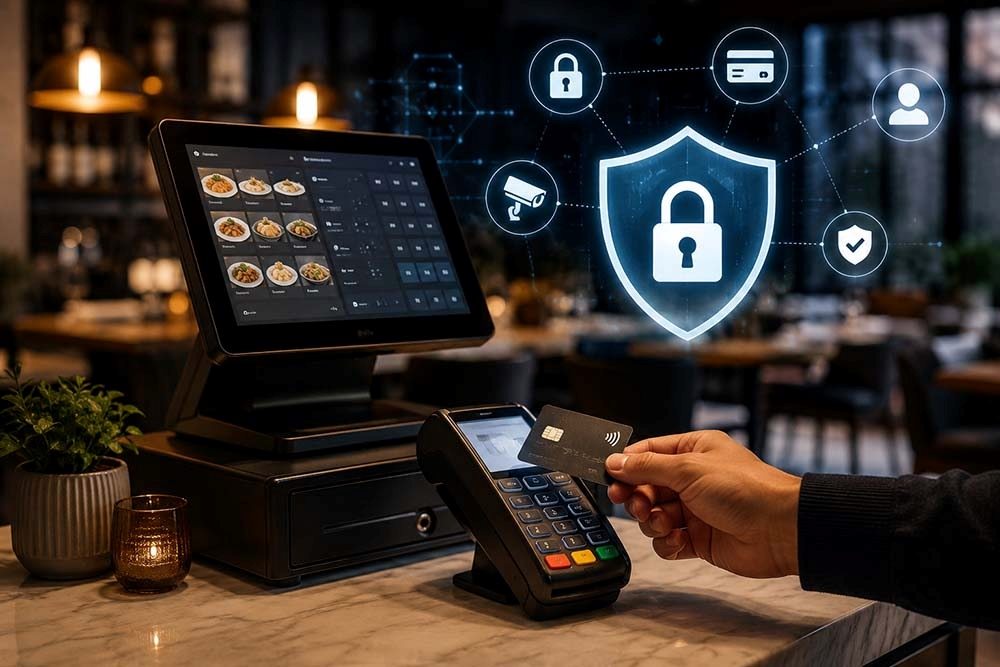
Restaurant payment systems connect terminals, staff accounts, networks, and, in some cases, online ordering platforms. That convenience also creates security risks. Restaurant POS security Canada 2026 should therefore be treated as an operational responsibility, not simply an IT problem.
Restaurants that accept payment cards need clear controls around devices, passwords, software, employee access, and service providers. Strong POS payment security Canada restaurant practices can reduce opportunities for fraud while helping businesses protect sensitive information.
What PCI DSS Means for Canadian Restaurants
PCI DSS is the Payment Card Industry Data Security Standard. It establishes technical and operational requirements for protecting payment account data. It applies to entities that store, process, or transmit cardholder data and organizations that can affect the security of the cardholder data environment.
PCI compliance restaurant POS Canada responsibilities do not disappear simply because payment processing is outsourced. Merchants remain responsible for confirming that relevant providers are PCI DSS compliant for their services, maintaining appropriate agreements, monitoring provider compliance, and understanding shared responsibilities.
Small restaurants should ask their acquirer or payment program contact which validation method applies. PCI compliance restaurant POS Canada requirements may involve an appropriate Self-Assessment Questionnaire depending on the payment environment.
How to Protect Customer Payment Data
The first rule is to minimize unnecessary payment data exposure. Restaurants should avoid storing card information unless there is a legitimate, properly secured business requirement.
To protect customer data, POS Canada 2026, use supported POS software, install security updates promptly, and apply secure system configurations. Strong passwords and multi-factor authentication should protect administrative accounts where available.
Staff access should follow the principle of least privilege. Servers, cashiers, managers, and administrators do not automatically need identical permissions. POS payment security, Canada restaurant policies should also require individual accounts rather than shared administrator credentials.
Separate payment systems from public guest Wi-Fi whenever possible. Restaurants should use appropriate network security controls and review connected devices regularly.
Common Restaurant POS Security Threats
Weak or stolen credentials are a major concern. The Office of the Privacy Commissioner of Canada reported that unauthorized access represented 78 percent of PIPEDA breaches reported by businesses in 2025–2026, with cybersecurity incidents responsible for 68 percent of those unauthorized-access breaches.
Restaurant POS security Canada 2026 planning should consider phishing, social engineering, malware, compromised passwords, unauthorized employee access, and poorly secured remote access. Physical tampering with payment devices is another risk.
Employees should know how to recognize unusual login requests, suspicious emails, unexpected support calls, and changes to payment terminals. Regular device inspections can help identify damaged, replaced, or altered equipment.
Restaurant Responsibilities Versus Provider Responsibilities
A common misconception is that the POS provider handles everything. Providers may secure hosted infrastructure, payment applications, or specific services, but the restaurant still controls important parts of its environment.
PCI compliance restaurant POS Canada is based on clearly understanding shared responsibilities. Restaurant owners may remain responsible for employee access, local networks, device security, password practices, physical controls, and compliance validation.
Ask providers for written documentation explaining security responsibilities. Confirm how updates are delivered, how incidents are reported, and whether third parties access the system remotely.
Building a Practical Security Routine
Effective restaurant POS security Canada 2026 does not require staff to become cybersecurity experts. It requires repeatable procedures.
Create a checklist for terminal inspections, employee account reviews, software updates, and provider compliance checks. Remove accounts immediately when employees leave. Restrict administrative privileges and review unusual system activity.
To protect customer data, POS Canada 2026, restaurants should also maintain an incident response plan. If a suspected breach occurs, isolate affected systems when appropriate, preserve relevant information, contact required providers, and follow applicable legal and contractual reporting obligations.
Under PIPEDA, businesses subject to the law must report security safeguard breaches that create a real risk of significant harm, notify affected individuals, and maintain records of breaches.
Training staff is equally important. Short, regular security reminders can strengthen POS payment security Canada restaurant operations by helping employees recognize threats before a suspicious action becomes a serious incident.
FAQ’s
Q1. What is PCI DSS compliance, and does my restaurant POS need it in Canada?
A: PCI DSS provides baseline security requirements for payment account data. It applies to entities involved in payment processing, including merchants. Even when processing is outsourced, restaurants retain responsibilities. Ask your acquirer or payment brand which validation requirements apply to your business.
Q2. How do I protect my customers’ payment data through my POS system?
A: Use supported software, prompt updates, strong passwords, multi-factor authentication, restricted access, secure networks, and trusted payment providers. Minimize stored card data and train employees to identify phishing, suspicious support requests, and payment device tampering.
Q3. What are the most common POS security breaches in Canadian restaurants?
A: Risks include stolen credentials, phishing, social engineering, malware, insecure remote access, excessive employee permissions, unpatched systems, and physical terminal tampering. Restaurants should monitor accounts, inspect devices, and maintain clear incident response procedures.
Q4. Does my restaurant POS provider handle security, or is that my responsibility?
A: Security is generally shared. A provider may secure its platform and services, while the restaurant remains responsible for local systems, staff access, passwords, devices, networks, and certain compliance tasks. Request a written responsibility breakdown from your provider.