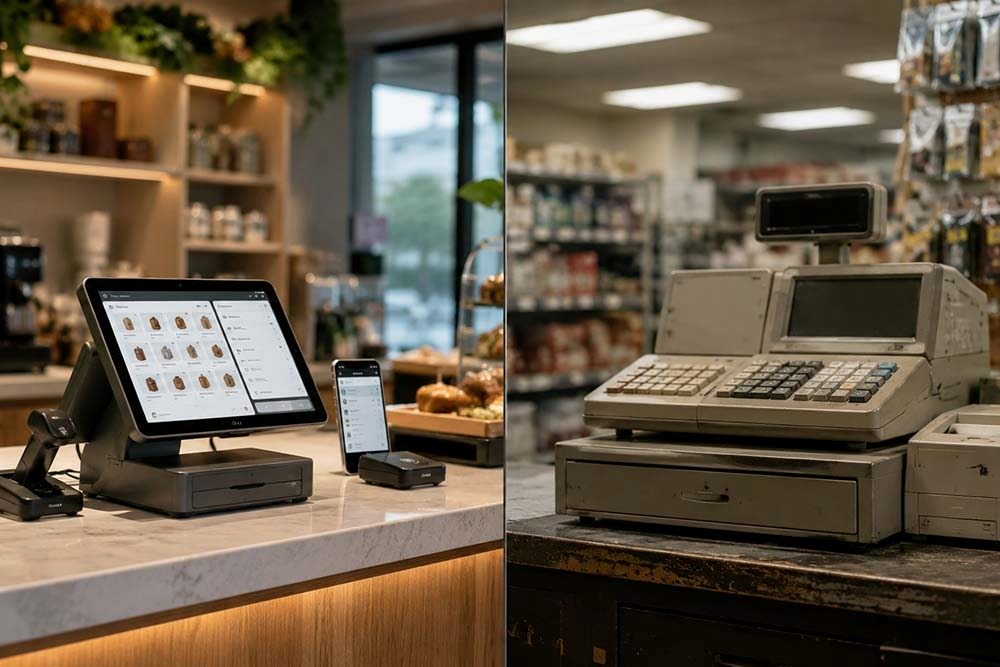
For Canadian businesses, a point-of-sale system is more than a cash register. The cloud POS vs legacy POS Canada 2026 decision now affects payments, inventory, reporting, customer data, integrations, and how easily a business can operate across locations.
A cloud-based POS system Canada 2026 stores and synchronizes much of its business data through online services, while a legacy system typically depends more heavily on local computers, servers, or software installed at the business. Traditional vs cloud POS Canada is therefore a question of flexibility, control, cost, connectivity, and risk.
How Cloud POS Systems Work
Cloud POS platforms usually allow owners to access sales reports, inventory, staff information, and other tools from connected devices.
For companies asking Should I switch to cloud POS Canada, this accessibility can be valuable. A multi-location retailer may see inventory and sales centrally, while a restaurant can connect ordering, payments, menus, and reporting through one platform.
The cloud POS vs legacy POS Canada 2026 comparison also includes scalability. Adding terminals, locations, integrations, or ecommerce capabilities may be easier with a cloud platform than with older locally hosted systems.
Why Legacy POS Still Has Advantages
Legacy systems should not automatically be viewed as obsolete. Some businesses rely on highly customized software, specialized hardware, local databases, or workflows developed over many years.
In the traditional vs cloud POS Canada debate, legacy systems can offer greater local control and may continue performing core functions during internet disruptions. Stable businesses may prefer avoiding migration.
However, older systems can create challenges involving hardware replacement, software support, security updates, remote access, and integrations. Before deciding whether to switch to cloud POS Canada, calculate the cost and operational risk of both staying and moving.
Does Cloud POS Work Without Internet?
Shopify POS, for example, supports offline checkout and can accept eligible card payments when offline payments are enabled in advance. However, Canadian businesses cannot accept Interac payments through Shopify’s offline card-payment feature.
Lightspeed also provides offline functionality for certain configurations, but some features become unavailable, and Canadian Interac transactions are not supported in its documented offline payment mode.
This makes internet resilience an important part of choosing a cloud-based POS system in Canada in 2026. Businesses should ask exactly which sales, payment, inventory, loyalty, and reporting functions remain available during an outage.
Security and Data Responsibilities
A cloud provider handling information does not eliminate a business’s privacy responsibilities. The Office of the Privacy Commissioner of Canada explains that organizations using cloud services must consider how personal information is collected, handled, protected, and transferred.
That means the operational convenience of connected systems must be balanced with strong security and privacy controls. When comparing traditional vs cloud POS Canada, ask where information is stored, who can access it, how accounts are authenticated, what backup procedures exist, and what happens if service is interrupted.
When Switching Makes Sense
A cloud-based POS system Canada 2026 may be especially useful for restaurants, retail stores, salons, cafés, franchises, mobile sellers, and growing multi-location companies. These businesses often benefit from centralized reporting, inventory synchronization, remote management, ecommerce integrations, staff tools, and faster feature updates.
If you are wondering whether to switch to cloud POS Canada, examine your current pain points first. Switching makes sense when the new system solves measurable problems such as disconnected inventory, limited reporting, difficult remote access, or inefficient multi-location management.
The cloud POS vs legacy POS Canada 2026 decision should not be driven by trends alone. Migration costs, staff training, data conversion, payment contracts, hardware compatibility, downtime, subscriptions, and integration gaps can offset expected benefits.
FAQ’s
Q1. What is the difference between a cloud and legacy POS system in Canada?
A: Cloud POS systems rely heavily on internet-connected services for data synchronization, reporting, updates, and integrations. Legacy systems generally store more data and software locally. The right choice depends on connectivity, complexity, and existing infrastructure.
Q2. Does a cloud POS system work without internet in Canada?
A: Sometimes. Many platforms provide limited offline functionality, but features and payment methods differ. Some Canadian systems cannot process Interac while offline, and offline card transactions may carry additional decline risk after reconnection.
Q3. What are the risks of switching from a legacy POS to cloud?
A: Risks include migration errors, staff disruption, recurring subscription costs, hardware replacement, internet dependence, integration problems, data-security concerns, and unexpected payment-processing changes. Test workflows and create a migration plan before replacing a system.
Q4. Which Canadian industries benefit most from a cloud POS system?
A: Retail, restaurants, hospitality, salons, service businesses, franchises, and multi-location operators often benefit most because centralized inventory, reporting, staff management, remote access, and integrations can reduce administrative work. The best platform depends on operational requirements.