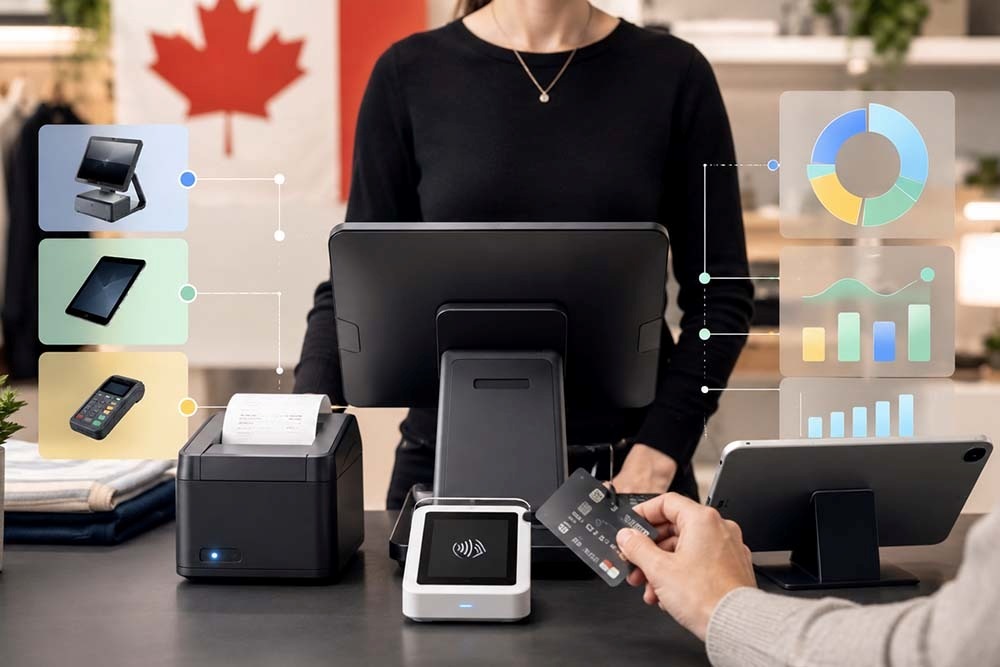
Choosing a point-of-sale system involves more than comparing the advertised monthly subscription. Canadian businesses may pay for hardware, software, payment processing, installation, support, integrations, and additional features. Understanding the POS system pricing Canada 2026 breakdown details can help small business owners calculate the actual cost before signing a contract.
What Makes Up a POS System Cost?
A typical POS setup combines physical equipment with software and payment processing. Hardware may include a touchscreen terminal, cash drawer, receipt printer, barcode scanner, card reader, customer display, or accessories.
Software provides functions such as sales tracking, inventory management, employee permissions, reporting, customer management, and integrations. Payment processing allows businesses to accept debit and credit card transactions.
When evaluating how much a POS system costs in Canada monthly in 2026, consider all three categories instead of focusing only on the advertised software subscription.
POS Hardware Costs
Hardware is usually an upfront expense, although some providers offer financing or equipment rental options. The price depends on the equipment required and the complexity of the setup.
A small retailer may only need a terminal and payment device, while a restaurant could require multiple stations, kitchen printers, customer displays, and specialized equipment.
POS hardware and software fees in Canada should be evaluated separately because a low monthly subscription may still involve significant equipment costs.
Ask whether hardware is purchased outright, leased, rented, or provided under a contract. Also check warranty coverage, replacement terms, and compatibility with future upgrades.
Software Subscription Fees
POS software is commonly charged monthly, although some providers offer annual plans or different pricing tiers. Basic plans may provide essential sales functions, while advanced packages can include inventory, analytics, loyalty programs, employee management, ecommerce integration, and reporting.
When reviewing POS system pricing Canada 2026 breakdown options, identify which features are included in the base plan and which require additional subscriptions.
Businesses should avoid paying for advanced features they will not use. At the same time, choosing an overly basic system can become expensive if important capabilities require multiple add-ons later.
Payment Processing Fees
Payment processing can represent one of the largest ongoing POS expenses. Businesses may pay processing fees based on transaction value and payment method.
The exact pricing structure varies between providers and agreements. Some contracts may advertise a simple rate, while others use different rates for different card types or transaction methods.
To calculate the total POS cost Canada small business 2026 owners should estimate monthly sales volume and average transaction size. A small difference in processing rates can become significant when transaction volume increases.
Hidden or Additional Fees
Businesses should examine contracts carefully for costs that are not obvious in promotional pricing. Possible charges may involve setup, installation, equipment replacement, software add-ons, premium support, early cancellation, chargebacks, integrations, or additional terminals.
Not every provider charges these fees, but asking about them before signing can prevent surprises.
When considering how much a POS system costs in Canada monthly in 2026, request a complete written quote showing recurring and one-time charges.
Is a Cheaper POS Worth It?
A cheaper POS system may be appropriate for a small business with straightforward needs. However, price should not be the only consideration.
Reliability, customer support, security, reporting, ease of use, scalability, and integration capabilities can affect the system’s overall value.
A low-cost system that frequently experiences downtime or requires expensive upgrades may cost more over time than a slightly more expensive solution with dependable functionality.
Calculate Your True Monthly Cost
To estimate the total cost, add the monthly software subscription, estimated processing fees, equipment financing or rental, support charges, and recurring add-ons. Then account for upfront hardware and installation costs separately.
For example, a business processing $40,000 monthly should pay close attention to transaction fees because they may have a larger financial impact than the software subscription.
This approach provides a more realistic POS system pricing Canada 2026 breakdown than comparing monthly software prices alone.
Conclusion
Understanding POS hardware and software fees in Canada is essential when comparing systems. The true total POS cost Canada small business 2026 depends on transaction volume, equipment, subscriptions, processing rates, and additional services. By calculating every expense and reviewing contract terms carefully, businesses can make a more informed decision. A detailed POS system pricing Canada 2026 breakdown helps owners choose a solution that balances affordability, reliability, functionality, and long-term value.
FAQ’s
Q1. What is the total monthly cost of a POS system in Canada?
A: It varies widely based on hardware, software, transaction volume, processing rates, features, and support. Calculate all recurring costs rather than relying on the advertised subscription.
Q2. Are there hidden fees in Canadian POS system contracts?
A: Some providers may charge additional fees for equipment, installation, integrations, support, cancellation, or optional features. Review the complete agreement before signing.
Q3. Is a cheaper POS system worth it for a Canadian small business?
A: It can be, if it meets the business’s operational needs. Compare reliability, features, support, processing costs, and scalability rather than price alone.
Q4. What is the difference between POS hardware and software fees in Canada?
A: Hardware fees cover physical equipment such as terminals, scanners, and printers. Software fees cover the digital platform and features used to manage sales and operations.